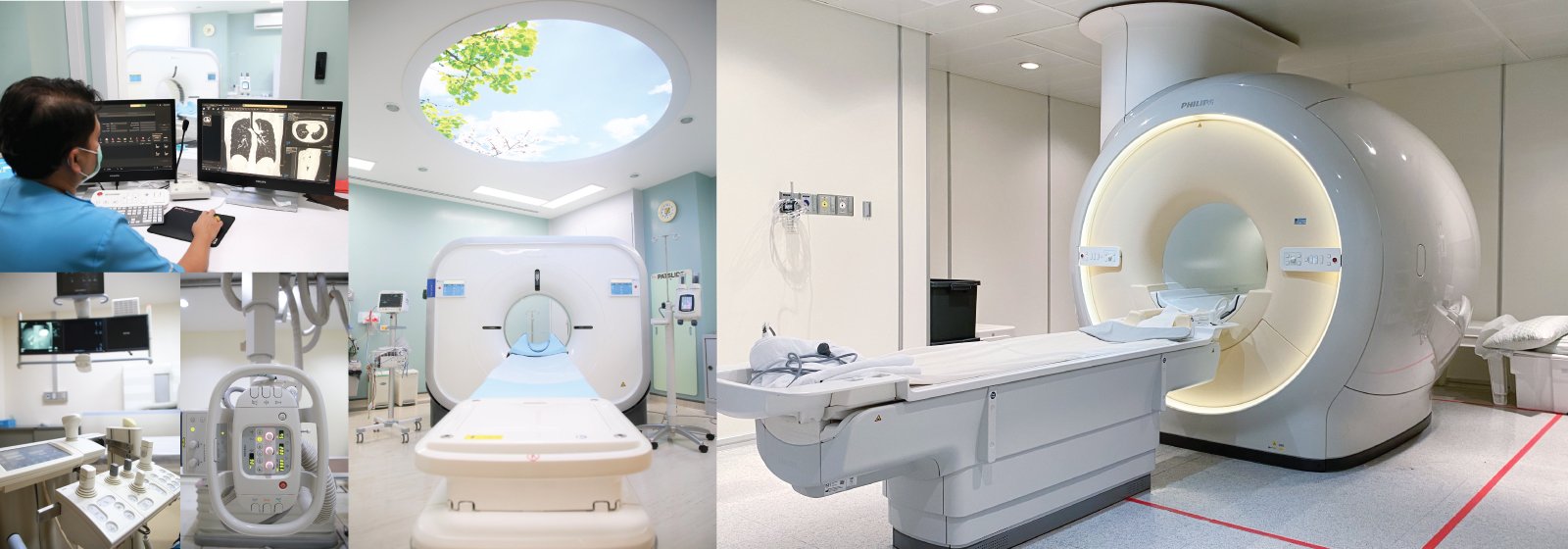
Provides diagnostic radiology services by a team of specialist physicians and knowledgeable, capable staff, supported by modern equipment and technology, delivering fast and efficient diagnostic examinations.
Services (Scope of Service)
General X-ray (General x-ray): a commonly familiar X-ray examination, such as chest X-ray, X-ray of arm/leg bones, spine X-ray, skull X-ray, etc.
Computed Tomography (CT) is a type of diagnostic radiology examination that uses X-rays rotating around the patient’s body, collecting data in 3D. A computer system then reconstructs the data into cross-sectional images and images in other planes, including 3D images, allowing internal organs to be seen clearly. It can be used to examine various parts of the body, such as:
CT scan of the brain and head
CT scan of the lungs and chest
CT scan of abdominal organs such as the liver, pancreas, kidneys, uterus, prostate gland, urinary bladder, etc.
CT scan of the spine, arms, legs, wrist, ankle, etc.
MRI (Magnetic Resonance Imaging) is an electromagnetic wave-based diagnostic tool used to detect abnormalities in the body. It uses a magnetic field and radiofrequency waves to create high-resolution images, helping doctors diagnose diseases in greater detail. Patients are not affected by X-ray radiation. It can examine almost every part of the body, such as:
Brain MRI and cerebral blood vessel MRI
Cervical spine and spinal MRI
Abdominal organ MRI, such as the liver, pancreas, kidneys, gallbladder, prostate, etc.
MRI of the shoulder, elbow, wrist, knee, ankle, etc.
eMammography is an examination that uses low-energy X-rays to create images of the breast for diagnostic purposes, to detect abnormalities from an early stage. It can be performed both when symptoms are present and when there are no abnormal symptoms. Research has found that having a mammogram every year can detect early-stage cancer, which greatly increases the chance of a complete cure without needing to remove the entire breast.
Ultrasound examination: Ultrasound is a safe method because it does not use radiation, so it is not harmful to children or pregnant women. It can be used to examine both
Upper abdominal ultrasound
Lower abdominal ultrasound for women (transabdominal, transvaginal)
Lower abdominal ultrasound for men; prostate ultrasound
Breast ultrasound
Ultrasound to detect abnormalities of arteries in the neck, veins in the legs, etc.
Special X-ray examinations and fluoroscopy X-ray
Examination of various organs of the body that requires the use of contrast media together with X-ray imaging. This type of examination varies in methods and procedures to ensure accurate diagnostic interpretation, such as:
Examination of the esophagus, stomach, and duodenum
Examination of the large intestine (colon)
Injection of contrast medium to detect abnormalities of the uterus and fallopian tubes
Bone density measurement (Bone Densitometry) is an examination to determine bone mineral density in different areas such as the spine, hip, and wrist. It can predict the future risk of bone fractures and assess the degree of osteoporosis by using low-energy DEXA scanner X-rays to image bone tissue. The results are obtained quickly, accurately, and safely.
- Location1st floor, Building A
- Operating hoursOpen daily 24 hours
- Phone038-320300 ext. 1146, 1148
- Emailinfossh@samitivej.co.th